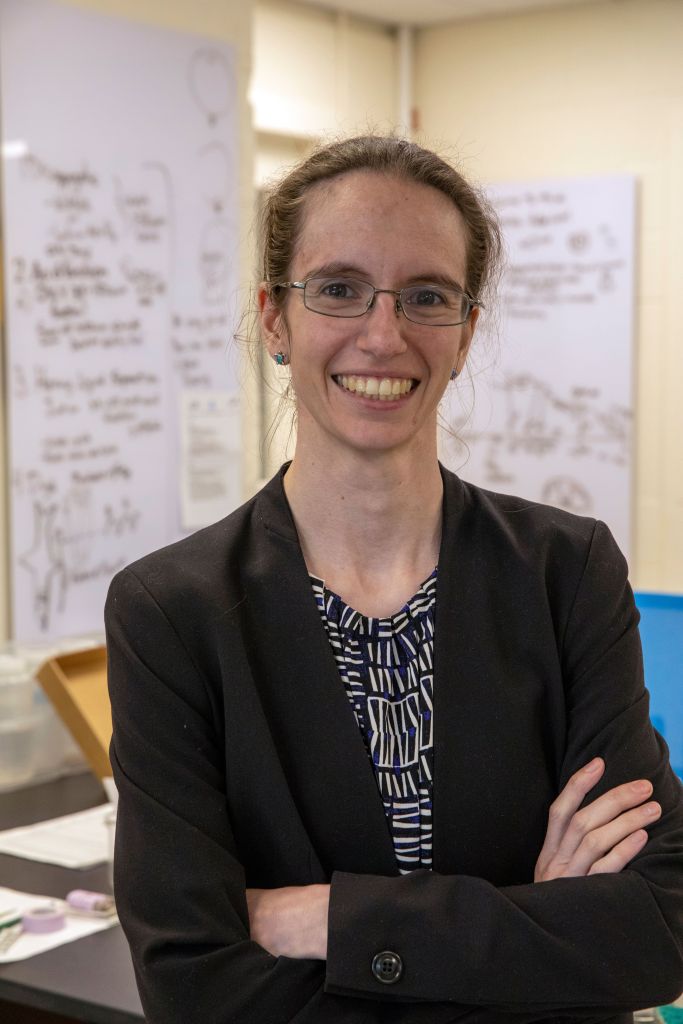
Welcome to the webpage for Dr. Elizabeth Sibert (sigh-burt, she/her). My research asks the question “How does the ocean, and marine life, work, in the past, present, and future?” I am broadly interested in the evolution, structure, and function of marine ecosystems, and how these ecosystems respond to global change. I specialize in ichthyoliths, tiny fossil fish teeth and shark scales found in marine sediments worldwide, which I incorporate with myriad other climate and biotic proxies to better understand the ecosystem as a whole. I focus on climate and biotic events in Earth’s more recent history, such as global warming and mass extinctions, as repeated tests of past global change to explore processes. I’ve always loved the ocean, from the moment I first learned of the creatures that could live their lives underwater. As I dug deeper into their biology, I learned that life in the oceans was intricately linked to the physical, geological, and chemical properties of the ocean itself, and I am fascinated by how these links work together to create the ocean world that we see today. Studying ecosystems in deep time gives a unique window into those process, and I am most interested in developing new ways of understanding our planet and the life it supports.

Research Opportunities: I am currently an Assistant Scientist at Woods Hole Oceanographic Institution, where I lead the Paleo-FISHES Lab (this stands for Paleobiology & Paleoceanography: Fossil Ichthyoliths, Sedimentary History, and Ecological Studies). If you are interested in research opportunities, please reach out via email – I’d love to hear from you! I may be accepting PhD students for the Fall 2025 cycle. I also support undergraduate and postdoctoral research opportunities. Please reach out to discuss, and consider applying to the WHOI SSF and/or Woods Hole PEP programs if you’re an undergrad, or the WHOI Postdoctoral Scholars program if you’re a postdoc. I am happy to discuss other research opportunities as appropriate. If you are an undergrad with a disability interested in shark science, check out Accessible Sharks.
Accessibility in STEM: In addition to my research, I am passionate about making science and research accessible to folks with disabilities (see Kingsbury et al 2020, JGE, and Cooke et al 2020, EOS). I have also been discovering the fun of 3D printing, mostly fossils and other teaching aids. My lab space is the first accessible lab space built at WHOI (though hopefully not the last!), and is available to any researcher in the area who needs such lab space. It includes a roll-under sink and fume hood, seated height counter space, ample open storage at a variety of heights, and numerous other accessibility features. You can find more information about the lab space including pictures, on my lab website’s Facilities Page. We realize that conflicting access needs exist, so if the space isn’t [yet] accessible to you, we’ll do our best make it so!
I am also a founder and co-organizer of Pal(a)eoPERCS, a weekly virtual seminar series that spotlights the global community early career researchers in Pal(a)eo-sciences.
Academic Positions and Education History: My previous positions include Associate Research Scientist (2022-2023) and Hutchinson Postdoctoral Fellow (2020-2022) at Yale University, hosted by Celli Hull, and Junior Fellow in the Harvard Society of Fellows (2016-2020). I completed my PhD in Oceanography in 2016 at Scripps Institution of Oceanography, under the guidance of my fantastic advisor, Dick Norris.
My CV (woefully un-updated) is available here, and you can also find me on Google Scholar.
You can contact me at esibert [at] whoi [dot] edu
Official WHOI Profile
Official Yale EPS Profile
Official Harvard EPS Profile
You can find me on Twitter @ElizabethSibert and on GitHub as esibert

And finally, if you’ve scrolled down this far – thanks for making it! As a bit of comic relief, I finally retired the head shot that was taken of me when I was 20, but in the spirit of “Academics with decades-old photos of them as their profile pictures on the internet”, I am archiving it here for posterity. Perhaps this will be an archive of a few more very outdated head shots in years to come.

 Elizabeth Sibert